Long before music became something to be streamed through a phone, songs in Kashmir were closely woven into everyday life. They accompanied weddings, festivals, seasonal celebrations and community gatherings, providing not only entertainment but also a way of passing traditions, memories and language from one generation to another.
Among the most recognisable forms of Kashmir’s folk tradition are Rouf, Wanwun and Chakri. While each has its own character and setting, together they form an important part of the Valley’s performing-arts heritage.
Rouf: Song Through Movement
Rouf is perhaps one of the most recognisable traditional dance forms associated with Kashmir.
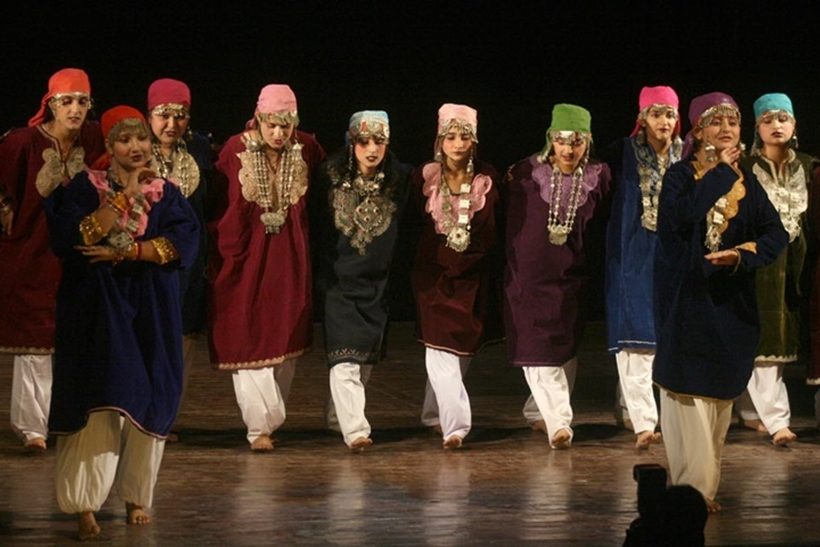
Traditionally performed by women, Rouf combines singing with coordinated movement. Performers commonly stand in rows or groups, linking arms or moving together in a rhythmic pattern. The movements are relatively simple, but their beauty comes from synchronisation — several people moving as one while singing together.
Rouf has traditionally been associated with celebrations and important occasions, including weddings and Eid, as well as cultural gatherings. Some accounts also connect the form with seasonal celebrations and the arrival of spring.
Unlike performances that depend heavily on elaborate instruments, the human voice and coordinated movement remain central to Rouf. That simplicity is part of its character.
The form also demonstrates how dance in Kashmir has historically functioned as a collective activity rather than simply a stage performance.
Wanwun: The Music of the Wedding Courtyard
If Rouf is remembered for its movement, Wanwun is particularly associated with its voices.
The word Wanwun is commonly described as referring to chorus singing. It has traditionally been performed during important rituals and celebrations, particularly Kashmiri weddings. Women gather together and sing in a call-and-response pattern, with one group taking a line before another responds.
The songs can carry blessings, good wishes and observations about the people and occasion being celebrated. Different stages of a wedding may have their own songs and verses, giving Wanwun a role within the ceremony rather than functioning simply as background music.
The form is also notable for its use of poetic devices such as metaphor, repetition, alliteration and simile.
For generations, this allowed knowledge of language, customs and social relationships to travel through song.
Wanwun has also crossed religious communities in Kashmir. Sources documenting the tradition describe its presence in both Muslim and Kashmiri Pandit wedding traditions, with differences in vocabulary and repertoire reflecting the respective cultural settings.
Chakri: Stories Set to Music
Chakri, meanwhile, occupies a different space within Kashmir’s folk music tradition.
It is a musical form built around a lead singer and responding voices, accompanied by traditional instruments. Instruments associated with Chakri include the rabab, sarangi, harmonium and noet, alongside other traditional percussion instruments.
One of Chakri’s important characteristics is storytelling.
Traditional Chakri performances have been used to narrate folk tales, romances and well-known stories, including Yusuf-Zulaikha and Laila-Majnun. In this sense, the music served as more than entertainment: it provided a way of transmitting stories to audiences through melody and performance.
The combination of a lead vocalist, responding chorus and instrumental accompaniment gives Chakri a distinctly communal character.
Where the Three Traditions Meet
Rouf, Wanwun and Chakri should not be treated as three interchangeable names for the same tradition.
Rouf is primarily recognised as a dance-song tradition.
Wanwun is strongly associated with ceremonial and wedding singing.
Chakri is a folk musical form with instrumental accompaniment and a strong storytelling tradition.
Yet they overlap in an important way: all three depend on collective participation.
They were not originally designed simply for an audience to watch from a distance. People sang, danced, played instruments, responded to one another and participated in the occasion itself.
That communal element helps explain why these forms have remained closely associated with weddings, festivals and other gatherings.
More Than Entertainment
Traditional music often preserves things that are difficult to record in books.
A Wanwun can preserve an old expression. A Chakri can keep a story alive. A Rouf performance can preserve a particular movement, rhythm or way of celebrating.
Research on Kashmir’s folk traditions has also described Rouf, Wanwun and Chakri as forms of cultural heritage through which social practices and collective memory are expressed.
Their importance, therefore, extends beyond performance. They provide a window into how communities celebrated, communicated and understood their own cultural world.
A Tradition Facing Change
Like many traditional art forms, Kashmiri folk traditions have also encountered changes brought by modern entertainment, changing lifestyles and shifts in how celebrations are organised.
Research on Kashmiri folk media has documented how forms such as Chakri and Rouf have been adapted for radio, television and modern cultural performances, while some traditional practices have become less common in urban settings.
Wanwun in particular has been described by cultural practitioners as losing some of its popularity among younger generations, raising questions about how traditional songs can be preserved while remaining relevant to contemporary audiences.
That does not necessarily mean these traditions are disappearing. They continue to appear at weddings, cultural programmes and community events, while musicians, researchers and cultural practitioners work to document and perform them in new settings.
Keeping the Sound Alive
The preservation of folk culture does not necessarily require keeping it frozen in the past.
Recording traditional songs, documenting their lyrics, teaching younger performers, supporting local artists and introducing these traditions through schools, cultural institutions and digital platforms can all help maintain their presence.
For Kashmir, where language, music, poetry and community traditions have historically been closely connected, preserving these forms also means preserving fragments of collective memory.
Rouf’s coordinated movements, Wanwun’s voices across a wedding courtyard and Chakri’s storytelling melodies represent different expressions of the same broader cultural landscape.
They remind us that Kashmir’s cultural history is not found only in monuments and manuscripts. It also lives in the songs people sing, the rhythms they remember and the movements they pass from one generation to another.